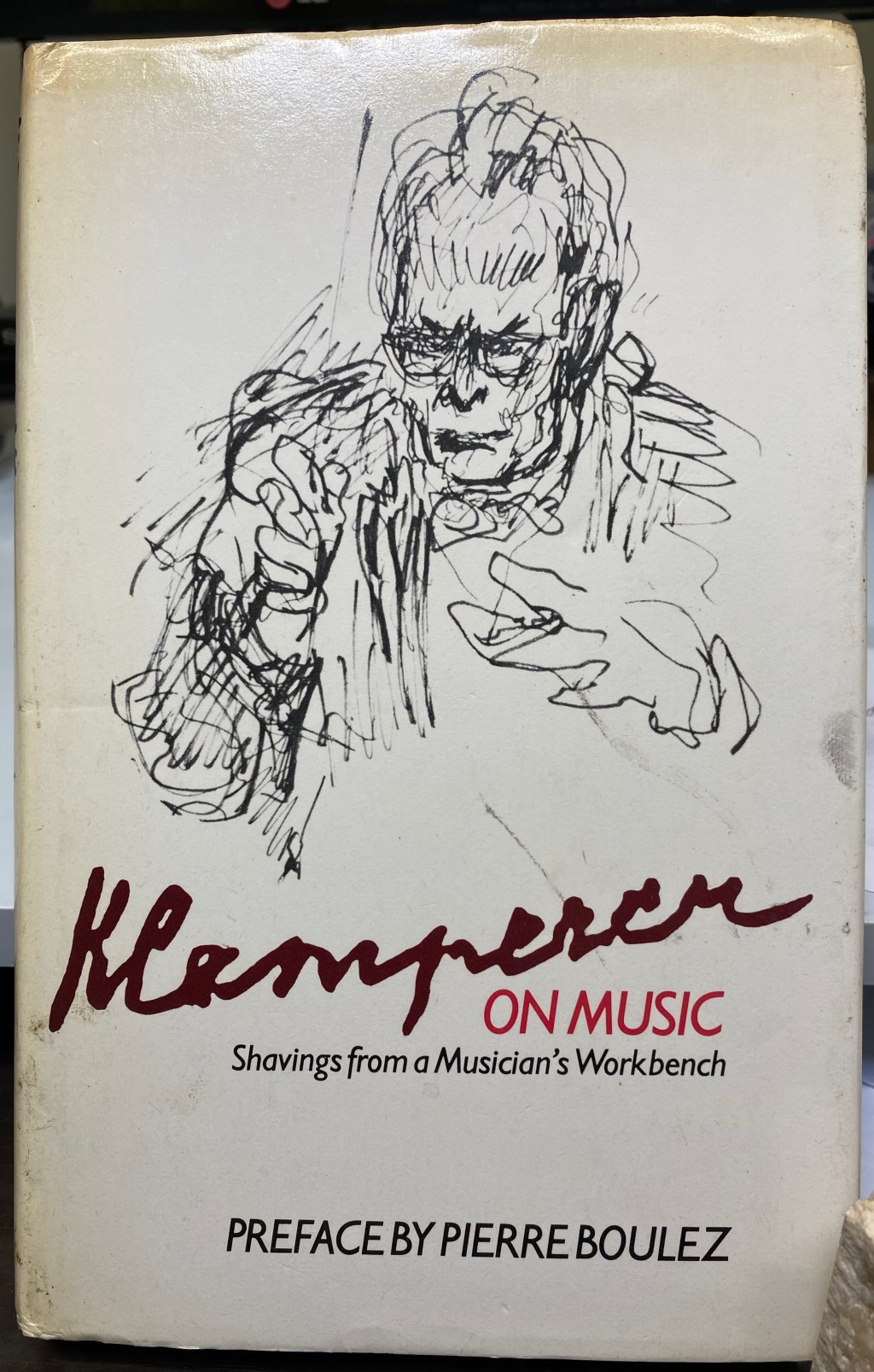
Klemperer <On Music> pp.97-100
以下的文章是1961年克倫培勒為貝多芬交響曲全套錄音配附的小冊子所寫的。它也於1964年的《小回憶錄》中發表。
我一生中經常指揮貝多芬的交響曲系列:1933年在洛杉磯、1935年在米蘭的史卡拉歌劇院、1936年在史特拉斯堡、1947年在布達佩斯、1949年在阿姆斯特丹、1957年和1959年在倫敦、以及1960年在維也納(與愛樂樂團)。結果是,隨著時間推移,我發現自己被貼上了“貝多芬專家”的標籤。
在我早年的日子裡情況完全不同。作為柏林(克洛爾(Kroll)歌劇院)國家資助劇院的指揮,我得以呈現許多新穎甚至實驗性的作品。因此在那些年,人們稱我為“現代指揮”。
但這兩個描述都不準確。我既不是貝多芬專家,也不是“現代”指揮。我目標的一直是在所有音樂風格中都能勝任指揮。
我經常遇到一些指揮家,他們在演奏一部現代作品時表現出色(我認為是這樣),而在演奏古典或浪漫時期的作品時卻毫無特色。這種明顯的不一致性的答案並不難找到:指揮家對現代作品的解讀同樣糟糕,但由於複雜的音調、管弦樂團出色的演奏或整體的不可驗證性,他的缺點被掩蓋了。在音樂領域沒有專家。在這裡,如同其他地方一樣,格言是“全力以赴”。
貝多芬是一位革命家,想像偉大的革命家像一隻行為良好、溫順的寵物狗一樣出現在德國舞臺上是極其錯誤的。他的交響曲至少是四隻手的事情。很少人熟悉貝多芬充滿訊息的節拍記號,儘管它們有時似乎非常快,只提供了他的音樂應該以何種速度演奏的粗略指示。
歌德,被認為對音樂不感興趣但實際上極富音樂天賦,聽到年輕的孟德爾頌演奏第五交響曲後,他評價道:“偉大,真是偉大!但是整個管弦樂隊演奏時聽起來會是怎樣!”歌德和貝多芬在特普利茨的著名會面以不愉快告終 – 這是不可避免的,因為歌德是貴族,而貝多芬是民主主義者。歌德稱貝多芬為“無拘束”的人格,但承認他從未遇過比貝多芬更“專注和沉著”的藝術家。兩人都欽佩拿破崙,但貝多芬聽說拿破崙稱帝後就回避了他。歌德一直別著法國榮譽軍團勳章,那是1808年拿破崙邀請他到埃佛時親自授予的,即便到解放戰爭後穿著由“外國征服者”賜予的勳章被認為是不德國的。
大多數人認為貝多芬是一個憂鬱、悲慘、陰鬱的人,但這是對他的粗糙扭曲。特別是在他年輕的時候,他是一個性格開朗、快樂的人。第一和第二號交響曲的語言是分毫無差的(unmistakable),甚至第四號交響曲也傳達出一種振奮的情緒。在這個時期,他與Therese von Brunswick相愛並半訂婚,她很可能是他“永恆的情人”,但最終並沒有結婚。
直到第六號交響曲,烏雲開始聚集。他的聽力逐漸惡化,但他進行了頑強的抗爭。“我將抓住命運的喉嚨。它永遠不會徹底羞辱我。”
隨著歲月流逝,貝多芬的音樂語言變得越來越高深,越來越難以理解和特立獨行。在他的《大賦格》(作品133)開頭貝多芬寫道:“有時自由,有時難懂”。這些話同樣可以用來形容第九號交響曲的最後樂章,它的形式解構和缺少奏鳴曲樂章、迴施曲、賦格– 然而,從這個蛹中湧現出了一些新的東西,一種狂喜。眾所周知,漢斯·馮·畢羅在晚年從不演奏第九號交響曲的結尾樂章,因為他認為它蘊藏著音樂頹廢的種子。多麼錯誤的看法!
關於貝多芬的樂器修飾和忠於原作之間的衝突有很多話可以說。兩派的想法同時對也同時錯。馬勒曾在他自己第八號交響曲的彩排中說過,在他過世後,任何人都可以對他作品中聽起來不對的部分作修改。理查·華格納和馬勒都對貝多芬進行了廣泛的修飾。今天我們覺得這是不必要的。此外:“讓每個人都看到他自己,看到他站在哪裡,並且當他站著時,確保他不會摔倒。”(出自歌德的<Beherzigung(沉思)>克倫培勒的一首聲樂及鋼琴作品以此為題)
關鍵不在於貝多芬的主題,而在於它們所謂的發展 – 儘管,正如約瑟夫·約阿幸所說,這是感知而不是表演的問題。
“但願從心靈到心靈”,貝多芬在他的《莊嚴彌撒》開頭寫道。這些美麗的文字可以作為他整個作品的紀念碑。
原文
the following essay was written in 1961 for the booklet accompanying Klemperer’s complete recording of the Beethoven Symphonies. It was also published in Minor Recollections in 1964.
I have very often conducted Beethoven cycles in the course of my long life: at Los Angeles in 1933, La Scala, Milan, in 1935, Strasbourg in 1936, Budapest in 1947, Amsterdam in 1949, London in 1957 and 1959, and Vienna in 1960 (with the Philharmonia). The result was that, as time went by, I found myself wearing a sort of dog-collar marked ‘Beethoven specialist’.
Things were very different in my earlier days. Having been engaged to direct the state-subsidisedStaatstheater in Berlin (the Kroll Opera), I was able to present a great deal that was new and even experimental. In those days, therefore, I was called a ‘modern conductor’.
Neither description is accurate. I am neither a Beethoven specialist nor a ‘modern’ conductor. My aim has always been to conduct competently in all musical styles.
I have often encountered conductors who give an excellent reading (as I think) of a contemporary work followed by an entirely unimpressive reading of a Classical or Romantic work. The answer to this apparent inconsistency is not hard to find: the reading of the modern work was equally bad, but the conductor’s shortcomings were disguised by the complex tonality, the orchestra’s brilliant playing, or the unverifiable nature of the whole. There are no specialists in the field of music. Here, as elsewhere, the maxim is ‘all or nothing’.
Beethoven was a revolutionary, and nothing could be more erroneous than to imagine that the great revolutionary arrived on the German scene like some well-behaved and docile lapdog. His symphonies are four-handed affairs, to say the least. Few people are familiar with Beethoven’s informative metronome markings, though they sometimes appear to be very fast and provide only a rough indication of the tempo at which his music should be played.
When Goethe, who is reputed to have been unmusical but was, in reality, extremely musical, heard the young Men- delssohn play the Fifth Symphony, his verdict was: ‘Great, truly great! But how it must sound when the whole orches- tra plays it!’
The celebrated encounter between Goethe and Beethoven at Teplitz ended in discord – inevitably so, becauseGoethe was an aristocrat and Beethoven a democrat. Goethe called Beethoven an unrestrained’ personality, butconceded that he had never met a more ‘dedicated and composed’ artist. Both men admired Bonaparte, but Beethoven recoiled from him on hearing that he had made himself Emperor. Goethe always wore the cross of the Légion d’Honneur with which Napoleon had personally invested him at Erfurt in 1808, and continued to do so even after the wars of liberation, when it was considered un-German to wear a decoration presented by the ‘foreign conqueror’.
Most people think of Beethoven as a melancholy, tragic, gloomy character, but this is a crude distortion. He was, particularly in his youthful years, a happy-natured, cheerful person. The language of the First and Second Symphonies is unmistakable, and even the Fourth conveys a mood of exaltation. At this period he was in love with and semi- engaged to Therese von Brunswick, who was probably his ‘unsterbliche Geliebte’, but it never came to marriage.
It was not until the Sixth Symphony that the clouds began to gather. His hearing deteriorated progressively, but he put up a stout fight. ‘I shall seize Fate by the throat. It will never humble me utterly.’
Beethoven’s musical language attained ever greater heights with the passage of the years, becoming more and more difficult and idiosyncratic. At the head of his Grosse Fuge (Op.133) Beethoven wrote: wrote: ‘tantôtlibre, tantôt recherché’. These words might equally be applied to the last movement of the Ninth Symphony, with its formal dissolution and absence of sonata movement, rondo and fugue – yet from this chrysalis there emerged something new, a sort of euphoria. It is well known that Hans von Bülow never performed the closing movement of the Ninth Symphony in his latteryears because he thought it harboured the seeds of musical decadence. What a misconception!
Much might be said about the instrumental retouching of Beethoven and the conflict between fidelity to the original and the reverse. Both schools of thought are at once right and wrong. Mahler once said at a rehearsal of his own Eighth Symphony that, after his death, anyone would be welcome to alter anything in his work which sounded wrong. Both Richard Wagner and Mahler subjected Beethoven to extensive retouching. Today we feel this to be unnecessary. Besides: ‘Let each man see to his own, see where he stands and, when he stands, see that he does not fall’.’
The essential point is not Beethoven’s themes, but their so-called development – although, as Joseph Joachim said, this is a question of perception rather than performance.
‘Von Herzen – möge es zu Herzen gehen [May it go from heart to heart]’, Beethoven wrote at the head of his MissaSolemnis. These beautiful words could stand as a memorial to his work as a whole.

 謝科比的大雜把園地
發表留言