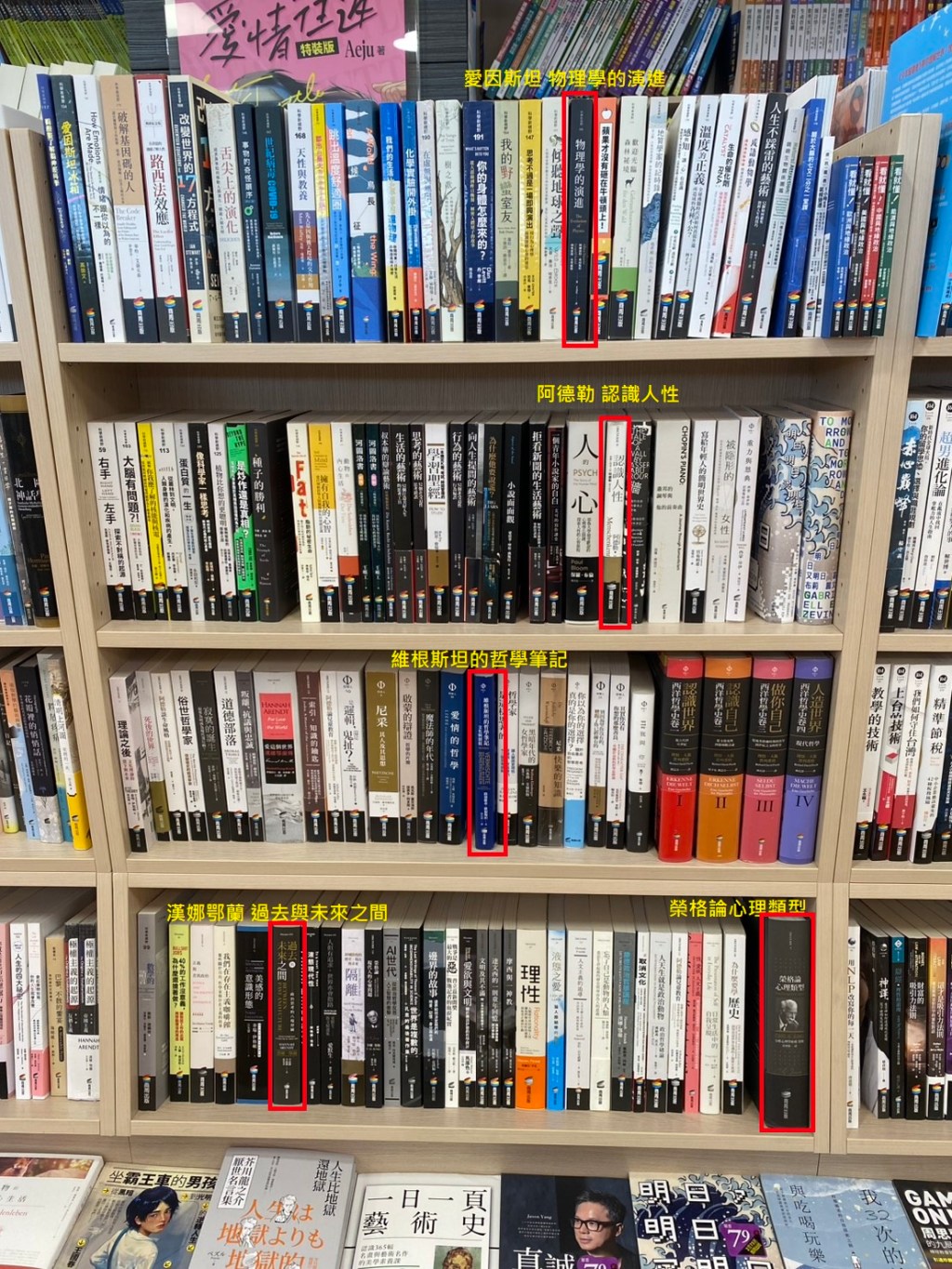
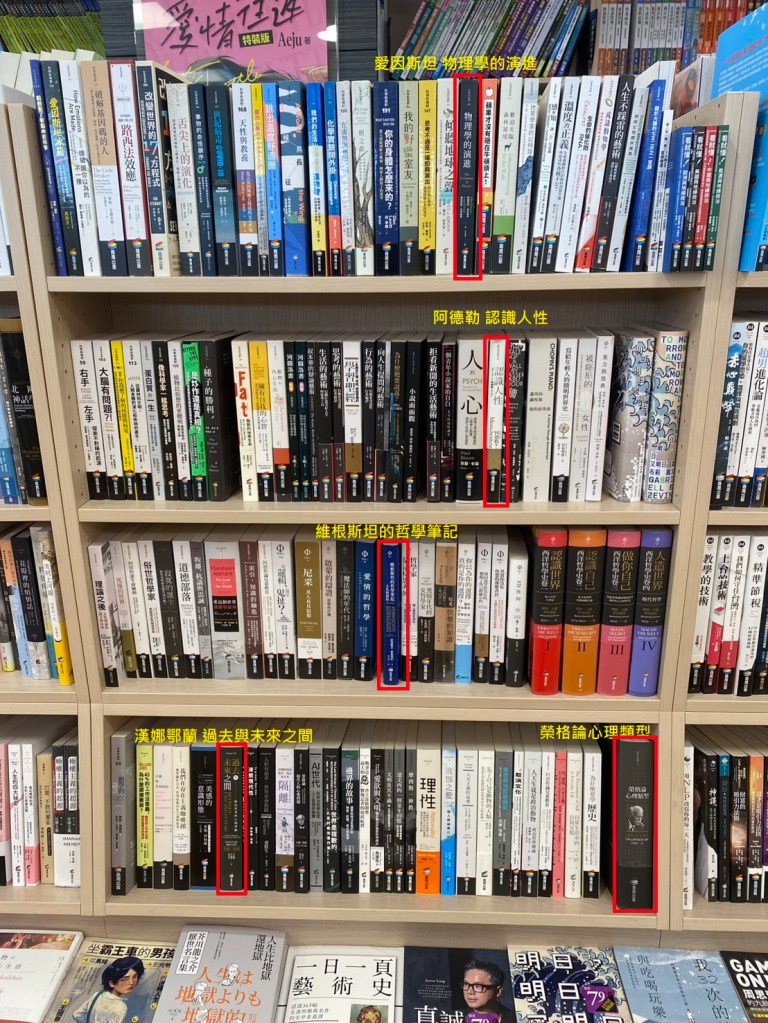
政大書局這次關門以後,我會很懷念這個架位。不知道多少個中午,吃飽飯去放風最後都站在這個架位前面。一眼瞄去架上至少買過5本書。雖然買回家不見得有時間看就是了。
愛因斯坦:物理學家心目中的大神,地位僅次於造物主。除了用相當簡潔的手法寫出驚天動地的特殊相對論,他的散文也是非常好讀的。雖然我不認同完全用實證精神看待世界萬物,但是讀愛因斯坦的書對拓展科學視野和了解大人物的想法非常有幫助。(這本沒買)
阿德勒:感覺他不是一個快樂的人,和佛洛依德分道揚鑣以後還是無法擺脫用「病」的角度看待人,但是阿德勒的書對人性仍然有相當精闢的見解。(買過)
漢娜鄂蘭:喜歡引用古希臘羅馬典故討論政治問題,對西方政治史如數家珍。只是學問太淵博、知識量太大、時空背景又太遙遠,讀得很累。(買過)
榮格:N年前起就一直想了解的榮格心理學,只是越讀越找不到怎麼體系性的把握住。不過多少讀了一些以後,「潛意識」不再只是純粹抽象的概念。(買過)
維根斯坦:在阪大讀研究所寫的第一篇報告,就是關於維根斯坦的成名作<邏輯哲學論>。裡面充滿神祕色彩的哲學論述,雖然書裡用原子排列般的世界秩序後來被維根斯坦本人否定,但無損作品本身的美。我認為把維根斯坦定位成「用哲學語言寫作的詩人/思想家」比定位成哲學家更正確。讓Chatgpt整理出章節最後的重點,還記得第一次讀到時候的震撼與感動。(但是跟做研究完全是兩回事)
6.4
All propositions are of equal value.
(所有命題都有相同的價值。)
6.41
The sense of the world must lie outside the world.
(世界的意義必須在世界之外。)
6.42
Hence also there can be no ethical propositions. Propositions cannot express anything higher.
(因此,也不存在倫理命題。命題無法表達任何「更高的」事物。)
6.44
It is not how things are in the world that is mystical, but that it exists.
(神秘的不是世界的樣子,而是世界存在這件事。)
6.5
When the answer cannot be put into words, neither can the question be put into words.
(當問題無法用語言表達,答案也就無法用語言表達。)
6.52
We feel that even if all possible scientific questions be answered, the problems of life have still not been touched at all.
(即使所有科學問題都被解答了,生命的問題仍未被觸及。)
6.54
My propositions serve as elucidations in the following way: anyone who understands me eventually recognizes them as nonsensical, when he has used them—as steps—to climb up beyond them. (He must, so to speak, throw away the ladder after he has climbed up it.)
(我的命題的作用是這樣的:理解我的人,最終會認出這些命題本身是無意義的,當他藉由它們「登上去」之後,必須把梯子丟掉。)
7.
What we cannot speak about we must pass over in silence.
(凡是不能說的,就應該保持沉默。)

 謝科比的大雜把園地
發表留言